Home »
Penelusuran Virtualization
During the VMworld event in Las Vegas, VMware has announced the new major update to their virtualization product, VMware vSphere 6.7 U1. This new release introducing new features and enhancements. Taken from VMware's blog official website witten by Adam Eckerle, here is the new things for this release.
- Fully Featured HTML-5 based vSphere Client
- vCenter Server Converge Tool
- Enhancements for HCI and vSAN
- Enhanced Content Library
- vMotion for NVIDIA vGPU VMs;Support for Inter FPGA
vSphere Client
From vSphere 6.7 U1 onward, the vSphere Client is the only client you’ll need to manage vCenter Server. all administrative functions have now been completed for the vSphere Client. No more switching between clients to perform actions such as setting up a vCenter HA (VCHA) cluster or using vSphere Update Manager (VUM) to update VMware Tools. Many of the latest additions have not only showed up in the vSphere Client but they’ve also been improved in the process.
vCenter Server Converge Tool
This tool allows an administrator to migrate from an external Platform Services Controller (PSC) architecture into the simpler, easy-to-manage embedded PSC architecture. This means fewer VMs to manage, no more load balancers for HA, and no complex multi-site replication topologies. While we announced support for Enhanced Linked Mode (ELM) with embedded PSCs for vSphere 6.7 and vSphere 6.5 U2, many customers already had external PSC topologies.
Enhancements for HCI and vSAN
In this release VMware added a new workflow called Cluster Quickstart which provides one simple, efficient wizard to create a cluster, add hosts, and configure those hosts so they are all identical. This configuration includes HA & DRS, Enhanced vMotion Compatibility (EVC), a vSAN datastore, and networking including a Virtual Distributed Switch (VDS). With Cluster Quickstart you can go from zero to fully functioning cluster in a matter of minutes. And, when it is time to expand the cluster, there is a simple workflow to add new hosts and configure them using the cluster settings used during initial setup. This new workflow also includes a cluster validation that can be used to ensure all settings have been properly configured on all hosts and will report any discrepancies.
Enhanced Content Library
Content Library in vSphere 6.7 Update 1 enables the importing of OVA templates from a HTTPS endpoint and local storage, as well as syncing content from OVA templates to other vCenter Servers. As part of the import of OVA templates, Content Library handles and verifies the OVA bundle’s certificate and manifest files in adherence to security best practices. In addition, Content Library now natively supports VM templates (VMTX) and associated operations such as deploying a VM directly from Content Library. These improvements make working with Content Libraries more efficient and prevent the need to copy objects in and out of Content Library to do meaningful operations. Note that syncing of VM templates to another vCenter Server is not yet available in vSphere 6.7 Update 1.
vMotion for NVIDIA vGPU & Support for Intel FPGA
With vSphere 6.7 Update 1, VMware and NVIDIA have collaborated to significantly enhance the operational flexibility and utilization of virtual infrastructure accelerated with NVIDIA virtual GPU (vGPU) solutions which include the Quadro virtual Data Center Workstation, GRID vPC and GRID vApps.
For completed article can be found at this url.
Source : https://blogs.vmware.com
Mpik
October 22, 2018
Admin
Bandung Indonesia
During the VMworld event in Las Vegas, VMware has announced the new major update to their virtualization product, VMware vSphere 6.7 U1. This new release introducing new features and enhancements. Taken from VMware's blog official website witten by Adam Eckerle, here is the new things for this release.
- Fully Featured HTML-5 based vSphere Client
- vCenter Server Converge Tool
- Enhancements for HCI and vSAN
- Enhanced Content Library
- vMotion for NVIDIA vGPU VMs;Support for Inter FPGA
vSphere Client
From vSphere 6.7 U1 onward, the vSphere Client is the only client you’ll need to manage vCenter Server. all administrative functions have now been completed for the vSphere Client. No more switching between clients to perform actions such as setting up a vCenter HA (VCHA) cluster or using vSphere Update Manager (VUM) to update VMware Tools. Many of the latest additions have not only showed up in the vSphere Client but they’ve also been improved in the process.
vCenter Server Converge Tool
This tool allows an administrator to migrate from an external Platform Services Controller (PSC) architecture into the simpler, easy-to-manage embedded PSC architecture. This means fewer VMs to manage, no more load balancers for HA, and no complex multi-site replication topologies. While we announced support for Enhanced Linked Mode (ELM) with embedded PSCs for vSphere 6.7 and vSphere 6.5 U2, many customers already had external PSC topologies.
Enhancements for HCI and vSAN
In this release VMware added a new workflow called Cluster Quickstart which provides one simple, efficient wizard to create a cluster, add hosts, and configure those hosts so they are all identical. This configuration includes HA & DRS, Enhanced vMotion Compatibility (EVC), a vSAN datastore, and networking including a Virtual Distributed Switch (VDS). With Cluster Quickstart you can go from zero to fully functioning cluster in a matter of minutes. And, when it is time to expand the cluster, there is a simple workflow to add new hosts and configure them using the cluster settings used during initial setup. This new workflow also includes a cluster validation that can be used to ensure all settings have been properly configured on all hosts and will report any discrepancies.
Enhanced Content Library
Content Library in vSphere 6.7 Update 1 enables the importing of OVA templates from a HTTPS endpoint and local storage, as well as syncing content from OVA templates to other vCenter Servers. As part of the import of OVA templates, Content Library handles and verifies the OVA bundle’s certificate and manifest files in adherence to security best practices. In addition, Content Library now natively supports VM templates (VMTX) and associated operations such as deploying a VM directly from Content Library. These improvements make working with Content Libraries more efficient and prevent the need to copy objects in and out of Content Library to do meaningful operations. Note that syncing of VM templates to another vCenter Server is not yet available in vSphere 6.7 Update 1.
vMotion for NVIDIA vGPU & Support for Intel FPGA
With vSphere 6.7 Update 1, VMware and NVIDIA have collaborated to significantly enhance the operational flexibility and utilization of virtual infrastructure accelerated with NVIDIA virtual GPU (vGPU) solutions which include the Quadro virtual Data Center Workstation, GRID vPC and GRID vApps.
For completed article can be found at this url.
Source : https://blogs.vmware.com
Red Hat, Inc. (NYSE: RHT) had announced the Red Hat Hyperconverged Infrastructure, the industry’s first production-ready fully open source hyperconverged infrastructure (HCI) solution. The Red Hat'way to implement the HCI is by combining innovative virtualization and storage technologies with a stable, proven operating platform. Red Hat Hyperconverged Infrastructure is designed to help enterprises to bring datacenter capabilities into locations with limited space, such as branch offices and other remote facilities.
Red Hat Hyperconverged Infrastructure uses Red Hat’s widely deployed virtualization platform, as well as software-defined storage, to more efficiently manage an integrated compute and storage infrastructure across a range of server hardware or networks. To accomplish this, Red Hat Hyperconverged Infrastructure was built with a suite of components, integrated to provide a unified experience from installation to management. These include:
- Red Hat Virtualization – The company’s award-winning Kernel-based Virtual Machine (KVM)-powered enterprise virtualization platform.
- Red Hat Gluster Storage – Highly scalable software-defined storage that can be converged on the same hardware as Red Hat Virtualization hosts, removing the need for additional compute infrastructures and simplifying deployment.
- Red Hat Enterprise Linux – The world’s leading enterprise Linux platform offers a stable and reliable foundation.
- Ansible by Red Hat – Deployment and management built on the leading simple, powerful, and agentless open source IT automation framework, providing automated installation and configuration from a central point.
The benefits that consolidation with a hyperconverged infrastructure provides:
- Eliminate storage as a discrete tier
- Easily virtualize business applications, maximizing resource utilization
- Single budget for compute and storage
- Single team managing infrastructure
- Simplified planning ans procurement
- Streamlined deployment and management
- Single support stack for compute and storage
Removing the storage tier by consolidating compute and storage onto a single server platform/tier offers streamlined deployment and management (enabled by Ansible by Red Hat and Red Hat CloudForms), a single support stack (one vendor to call now instead of two), and simplified planning and procurement (reducing the number of vendors to source from).
Source : http://redhatstorage.redhat.com
Mpik
July 04, 2017
Admin
Bandung Indonesia
Red Hat, Inc. (NYSE: RHT) had announced the Red Hat Hyperconverged Infrastructure, the industry’s first production-ready fully open source hyperconverged infrastructure (HCI) solution. The Red Hat'way to implement the HCI is by combining innovative virtualization and storage technologies with a stable, proven operating platform. Red Hat Hyperconverged Infrastructure is designed to help enterprises to bring datacenter capabilities into locations with limited space, such as branch offices and other remote facilities.
Red Hat Hyperconverged Infrastructure uses Red Hat’s widely deployed virtualization platform, as well as software-defined storage, to more efficiently manage an integrated compute and storage infrastructure across a range of server hardware or networks. To accomplish this, Red Hat Hyperconverged Infrastructure was built with a suite of components, integrated to provide a unified experience from installation to management. These include:
- Red Hat Virtualization – The company’s award-winning Kernel-based Virtual Machine (KVM)-powered enterprise virtualization platform.
- Red Hat Gluster Storage – Highly scalable software-defined storage that can be converged on the same hardware as Red Hat Virtualization hosts, removing the need for additional compute infrastructures and simplifying deployment.
- Red Hat Enterprise Linux – The world’s leading enterprise Linux platform offers a stable and reliable foundation.
- Ansible by Red Hat – Deployment and management built on the leading simple, powerful, and agentless open source IT automation framework, providing automated installation and configuration from a central point.
The benefits that consolidation with a hyperconverged infrastructure provides:
- Eliminate storage as a discrete tier
- Easily virtualize business applications, maximizing resource utilization
- Single budget for compute and storage
- Single team managing infrastructure
- Simplified planning ans procurement
- Streamlined deployment and management
- Single support stack for compute and storage
Removing the storage tier by consolidating compute and storage onto a single server platform/tier offers streamlined deployment and management (enabled by Ansible by Red Hat and Red Hat CloudForms), a single support stack (one vendor to call now instead of two), and simplified planning and procurement (reducing the number of vendors to source from).
Source : http://redhatstorage.redhat.com
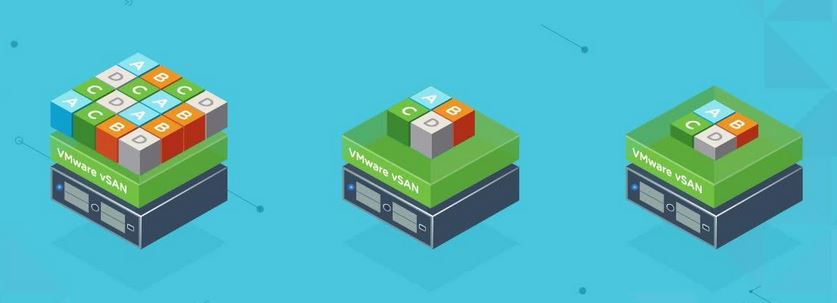
vSAN is VMware’s industry-leading software powering Hyper-Converged Infrastructure solutions.
vSAN 6.6 enhances the industry’s most popular HCI solution with the first native HCI security, highly available stretched clusters, and 50% higher all-flash performance for business-critical and next-generation workloads.

Industry's First Native HCI Encryption
vSAN offers the first native HCI encryption solution for data-at-rest, protecting critical data from unwanted access. vSAN encryption delivers lower costs and greater flexibility by being hardware agnostic and by offering simplified key management. No more requirements to deploy specific self-encrypting drives (SEDs). vSAN encryption is also built for compliance with support for 2-factor authentication (SecurID and CAC) and is the first HCI solution with a DISA-approved STIG.
Stretched Cluster with Local Site Protection
New enhanced stretched clusters with local site protection provide protection against both site failures and local component failures at 50% lower cost than traditional solutions. With a comprehensive stretched cluster solution, you can extend the cost and simplicity benefits of HCI to your disaster recovery and business continuity needs.
vSAN Cloud Analytics
With vSAN Cloud Analytics, you can decrease operational costs with pro-active, real-time support notifications and recommendations. The analytics tool delivers custom, real-time alerts through vSAN Health Service with custom actionable insights and remediation recommendations.
Unicast Networking
vSAN now supports unicast networking to help simplify your initial vSAN setup. You can utilize unicast for vSAN networking and there is no need to setup multicast anymore. This enables vSAN to be deployed in a wider set of on-premise and cloud environments without requiring network changes.
vSAN Management Pack for vRealize Operations
The new vSAN Management Pack for VMware vRealize Operations Manager provides additional options for monitoring, managing and troubleshooting vSAN along with end-to-end infrastructure solutions. With the vSAN management pack, you can gain insights about the impact of vSAN in your infrastructure quickly, and bring your business greater efficiency in shorter time.
Always-On Protection with Enhanced Availability
With new always-on protection features, vSAN keeps your applications running and available despite potential hardware challenges. New Degraded Device Handling (DDH) intelligently monitors the health of drives and proactively evacuates data before failures can happen. New smart drive rebuilds and partial rebuilds deliver faster recovery during hardware failures and decrease cluster traffic for greater performance.
Intelligent Operations and Lifecycle Management
New intelligent operations and lifecycle management capabilities accelerate initial hardware setup, simplify software install, and deliver 1-click controller hardware lifecycle management for a more predictable hardware experience. You can reduce management time up to 80% for common tasks with 1-click automation.
Up to 50% Higher All-Flash Performance
Optimized data services further extend vSAN’s performance advantage by delivering up to 50% more IOPS per all-flash host versus previous versions of vSAN, enabling over 150K IOPS per host. The increased performance helps accelerate mission critical applications and provides higher consolidation ratios for workloads.
Support of Next-Generation Workloads
New validated architectures provide a proven path for deploying next-generation applications like Splunk, Big Data, and Citrix XenApp. In addition, vSAN for Photon is now available in Photon Platform 1.1 and a new Docker Volume Driver delivers support for multi-tenancy, policy based management, snapshots and clones.
Day 1 Support of New Hardware Technologies
Customers can accelerate new hardware adoption with Day 1 support of the latest flash technologies, including solutions like the new Intel Optane 3D XPoint NVMe SSDs. In addition, vSAN now offers larger caching drive options, including 1.6TB flash drives, so that customers can take advantage of the latest and larger capacity flash drives.
Certified File Services and Data Protection Solutions
The VMware Ready for vSAN Program enables customers to extend and complement their vSAN environment with proven, industry-leading data protection and file service solutions from 3rd party partners.
Source : vmaware.com
Mpik
June 15, 2017
Admin
Bandung Indonesia
vSAN is VMware’s industry-leading software powering Hyper-Converged Infrastructure solutions.
vSAN 6.6 enhances the industry’s most popular HCI solution with the first native HCI security, highly available stretched clusters, and 50% higher all-flash performance for business-critical and next-generation workloads.
Industry's First Native HCI Encryption
vSAN offers the first native HCI encryption solution for data-at-rest, protecting critical data from unwanted access. vSAN encryption delivers lower costs and greater flexibility by being hardware agnostic and by offering simplified key management. No more requirements to deploy specific self-encrypting drives (SEDs). vSAN encryption is also built for compliance with support for 2-factor authentication (SecurID and CAC) and is the first HCI solution with a DISA-approved STIG.
Stretched Cluster with Local Site Protection
New enhanced stretched clusters with local site protection provide protection against both site failures and local component failures at 50% lower cost than traditional solutions. With a comprehensive stretched cluster solution, you can extend the cost and simplicity benefits of HCI to your disaster recovery and business continuity needs.
vSAN Cloud Analytics
With vSAN Cloud Analytics, you can decrease operational costs with pro-active, real-time support notifications and recommendations. The analytics tool delivers custom, real-time alerts through vSAN Health Service with custom actionable insights and remediation recommendations.
Unicast Networking
vSAN now supports unicast networking to help simplify your initial vSAN setup. You can utilize unicast for vSAN networking and there is no need to setup multicast anymore. This enables vSAN to be deployed in a wider set of on-premise and cloud environments without requiring network changes.
vSAN Management Pack for vRealize Operations
The new vSAN Management Pack for VMware vRealize Operations Manager provides additional options for monitoring, managing and troubleshooting vSAN along with end-to-end infrastructure solutions. With the vSAN management pack, you can gain insights about the impact of vSAN in your infrastructure quickly, and bring your business greater efficiency in shorter time.
Always-On Protection with Enhanced Availability
With new always-on protection features, vSAN keeps your applications running and available despite potential hardware challenges. New Degraded Device Handling (DDH) intelligently monitors the health of drives and proactively evacuates data before failures can happen. New smart drive rebuilds and partial rebuilds deliver faster recovery during hardware failures and decrease cluster traffic for greater performance.
Intelligent Operations and Lifecycle Management
New intelligent operations and lifecycle management capabilities accelerate initial hardware setup, simplify software install, and deliver 1-click controller hardware lifecycle management for a more predictable hardware experience. You can reduce management time up to 80% for common tasks with 1-click automation.
Up to 50% Higher All-Flash Performance
Optimized data services further extend vSAN’s performance advantage by delivering up to 50% more IOPS per all-flash host versus previous versions of vSAN, enabling over 150K IOPS per host. The increased performance helps accelerate mission critical applications and provides higher consolidation ratios for workloads.
Support of Next-Generation Workloads
New validated architectures provide a proven path for deploying next-generation applications like Splunk, Big Data, and Citrix XenApp. In addition, vSAN for Photon is now available in Photon Platform 1.1 and a new Docker Volume Driver delivers support for multi-tenancy, policy based management, snapshots and clones.
Day 1 Support of New Hardware Technologies
Customers can accelerate new hardware adoption with Day 1 support of the latest flash technologies, including solutions like the new Intel Optane 3D XPoint NVMe SSDs. In addition, vSAN now offers larger caching drive options, including 1.6TB flash drives, so that customers can take advantage of the latest and larger capacity flash drives.
Certified File Services and Data Protection Solutions
The VMware Ready for vSAN Program enables customers to extend and complement their vSAN environment with proven, industry-leading data protection and file service solutions from 3rd party partners.
Source : vmaware.com